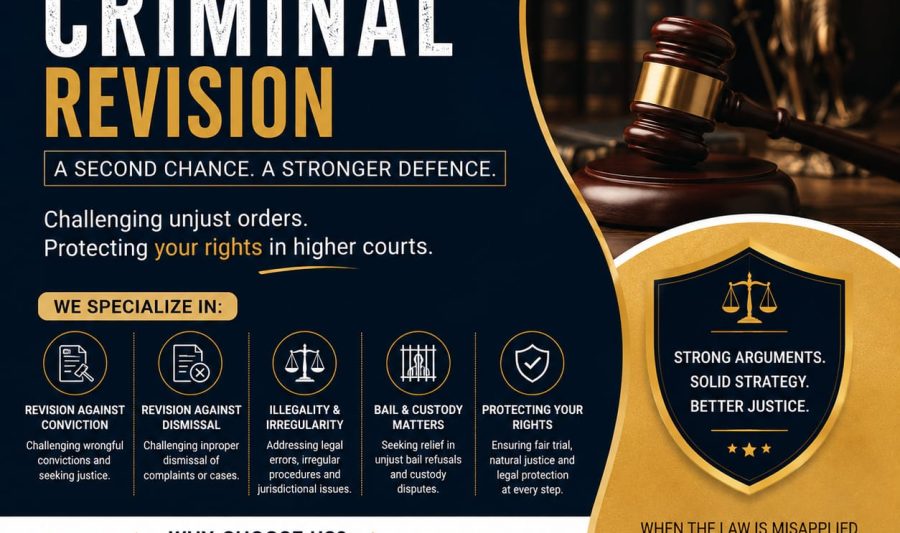
Criminal Revision Cases in India: Understanding Your Legal Remedy Against Judicial Errors
Criminal revision is an important legal remedy available under the Bharatiya Nagarik Suraksha Sanhita (BNSS), 2023(which replaced the Code of Criminal Procedure, 1973). It empowers higher courts to examine the correctness, legality, and propriety of orders passed by subordinate criminal courts. Unlike an appeal, a criminal revision is not a rehearing of the entire case. Instead, it is intended to correct legal errors, jurisdictional mistakes, procedural irregularities, or instances where justice may have been compromised.
What Is a Criminal Revision?
A criminal revision petition is filed before the Sessions Court or the High Court when a party believes that a lower court has committed a legal or procedural error. The revisional court primarily reviews the legality, regularity, and propriety of the proceedings rather than reassessing all evidence.
Criminal revision serves as a supervisory jurisdiction, ensuring that subordinate courts act within the framework of law and deliver fair justice.
When Can a Criminal Revision Be Filed?
A criminal revision may be appropriate in situations such as:
- Incorrect interpretation or application of the law.
- Procedural irregularities affecting the fairness of proceedings.
- Orders passed without proper jurisdiction.
- Violation of principles of natural justice.
- Improper dismissal of complaints.
- Incorrect framing or discharge of charges.
- Illegal or arbitrary interlocutory orders where revision is maintainable.
- Errors resulting in miscarriage of justice.
Who Can File a Criminal Revision?
A criminal revision petition may be filed by:
- The accused.
- The complainant.
- The victim.
- The prosecution, where permitted by law.
- Any person directly affected by the order.
The petition should clearly explain the legal errors and the relief sought from the revisional court.
Difference Between Criminal Appeal and Criminal Revision
Although both remedies challenge court orders, they differ significantly.
Criminal Appeal
- Statutory right where provided by law.
- May involve reappreciation of evidence.
- Can result in modification or reversal of findings.
Criminal Revision
- Discretionary remedy.
- Focuses on legality, propriety, and jurisdiction.
- Generally does not involve a fresh appreciation of evidence unless necessary to prevent injustice.
Powers of the Revisional Court
The revisional court may:
- Call for records from the subordinate court.
- Examine the legality and correctness of proceedings.
- Set aside illegal or improper orders.
- Modify certain orders where legally permissible.
- Direct fresh consideration by the lower court.
- Prevent abuse of the judicial process.
However, revisional jurisdiction is exercised cautiously and only where substantial injustice or legal error is demonstrated.
Documents Required for Filing Criminal Revision
Common documents include:
- Certified copy of the impugned order.
- Revision petition.
- Synopsis of facts.
- Grounds for revision.
- Relevant court records and supporting documents.
- Affidavit, if required.
- Vakalatnama executed in favor of the advocate.
Additional documents may be required depending on the facts of the case.
Why Professional Legal Assistance Matters
Criminal revision petitions involve technical legal issues and procedural requirements. An experienced criminal lawyer can:
- Evaluate whether revision is the appropriate remedy.
- Identify jurisdictional and legal defects.
- Draft comprehensive revision petitions.
- Present persuasive legal arguments before the Sessions Court or High Court.
- Protect the client’s legal rights throughout the proceedings.
Conclusion
Criminal revision is an essential safeguard within India’s criminal justice system. It enables higher courts to rectify legal errors, procedural irregularities, and jurisdictional mistakes committed by subordinate courts. If you have received an order that appears legally incorrect or unjust, seeking timely legal advice can help determine whether filing a criminal revision petition is the appropriate course of action. Proper legal representation significantly improves the chances of obtaining a fair and lawful outcome.