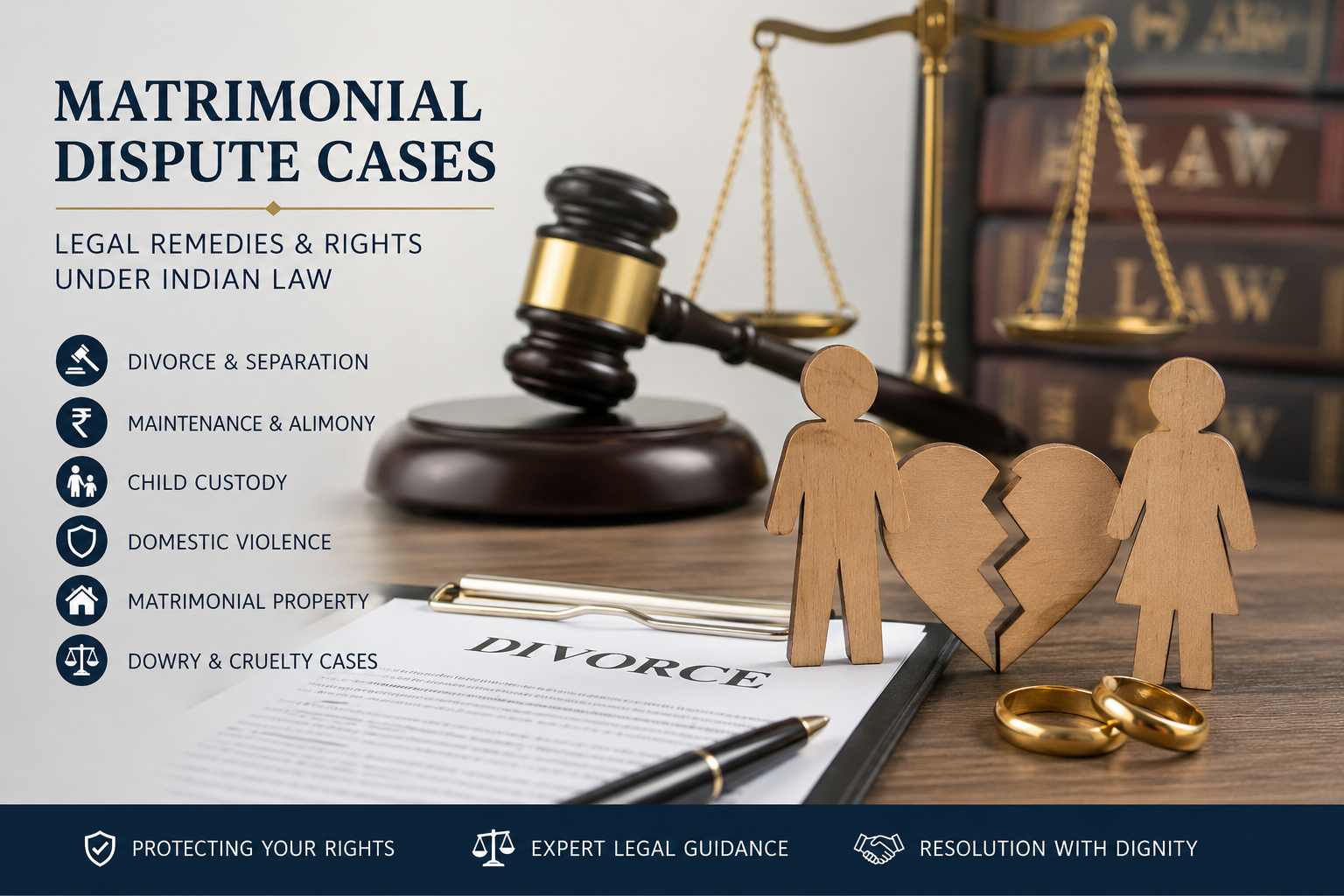
Divorce Cases in India: Legal Process, Grounds and Important Considerations
Divorce is a significant legal process that formally ends a marriage. In India, divorce laws depend on the personal law applicable to the spouses. Common legal frameworks include the Hindu Marriage Act, 1955, the Special Marriage Act, 1954, and other personal laws.
What Are Divorce Cases?
Divorce cases involve legal proceedings through which a married couple seeks dissolution of their marriage. A divorce may be filed by one spouse as a contested divorce or jointly by both spouses as a mutual consent divorce.
Common Grounds for Divorce
Depending on the applicable law, grounds may include:
- Cruelty
- Adultery
- Desertion
- Conversion of religion
- Mental disorder in circumstances recognized by law
- Certain serious diseases or circumstances recognized under applicable law
- Renunciation of the world
- Presumption of death
- Irretrievable breakdown of marriage in appropriate cases before the Supreme Court
The exact grounds and legal requirements depend on the applicable statute and facts of the case.
Mutual Consent Divorce
In a mutual consent divorce, both spouses agree that the marriage should end and jointly approach the appropriate court. They generally need to reach agreement on important issues such as maintenance or alimony, child custody, visitation rights, and division or settlement of financial and property-related matters.
A mutual divorce can often be less contentious than a contested proceeding, but the statutory requirements and court procedure must still be followed.
Contested Divorce
A contested divorce arises when one spouse seeks divorce and the other spouse does not agree to it or disputes the allegations. The court may consider pleadings, documents, evidence and witness testimony before deciding the matter.
Depending on the circumstances, related proceedings may involve maintenance, child custody, domestic violence, property disputes or other family-law issues.
Role of a Divorce Lawyer
An experienced divorce lawyer can help a spouse understand the applicable law, evaluate the available legal remedies, prepare pleadings and supporting documents, and represent the client before the appropriate court. Legal advice is particularly important where children, substantial financial assets, maintenance claims or allegations of cruelty or domestic violence are involved.
Key Considerations Before Filing
Before initiating divorce proceedings, it is advisable to understand:
- Which personal law applies to the marriage.
- Whether the case is suitable for mutual consent or contested proceedings.
- The appropriate court and jurisdiction.
- Available evidence and supporting documents.
- Potential maintenance and alimony issues.
- Child custody and visitation arrangements.
- Financial and property-related concerns.
- Possible mediation or settlement opportunities.
Conclusion
Divorce cases require careful consideration of both legal and personal circumstances. A well-prepared case can help protect important rights relating to marriage, finances, children and future obligations. Anyone considering divorce should obtain advice based on the specific facts of their case rather than relying solely on general information available online.