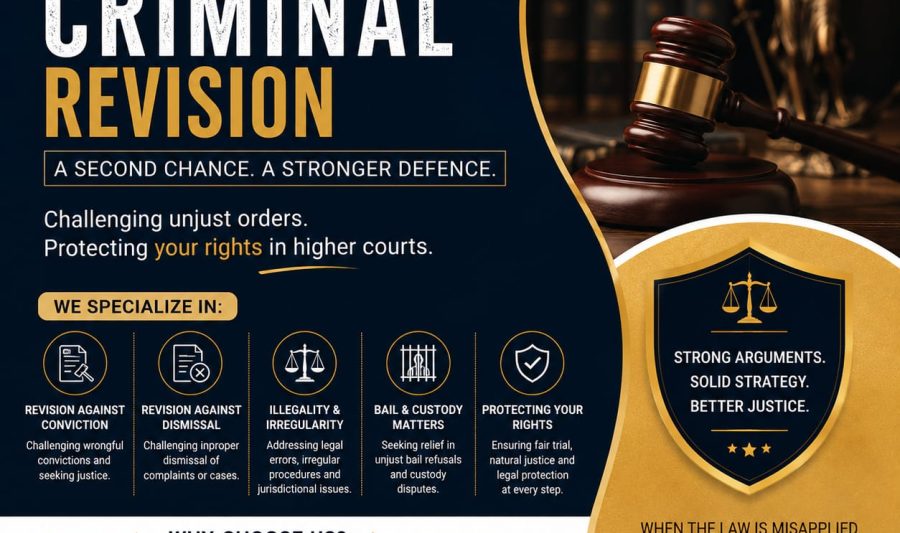
What Is a Criminal Revision Case and What Is Its Impact?
A criminal revision case is a legal remedy used to challenge an order, finding, sentence, or proceeding of a subordinate criminal court when there is an alleged illegality, incorrectness, impropriety, or procedural irregularity. Under the Bharatiya Nagarik Suraksha Sanhita, 2023 (BNSS), the principal provisions dealing with criminal revision are Sections 438 to 442. Section 438 empowers the High Court or Sessions Judge to call for and examine the record of a subordinate criminal court.
When Can a Criminal Revision Be Filed?
A criminal revision may be considered where a lower court has:
- Passed an order that appears legally incorrect.
- Failed to follow the required legal procedure.
- Exercised jurisdiction improperly.
- Passed an improper or irregular finding or sentence.
- Caused a potential miscarriage of justice.
- Committed a serious procedural error affecting the rights of a party.
The revisional court generally exercises a supervisory and corrective jurisdiction, rather than conducting the matter as a complete appeal. The objective is to examine the legality, correctness and propriety of the impugned order or proceeding.
Criminal Revision Under BNSS
With the BNSS coming into force on 1 July 2024, the provisions that were earlier contained in Sections 397–401 of the CrPC are now principally covered by Sections 438–442 of the BNSS. Section 438 concerns calling for records, Section 439 deals with the power to order inquiry, Section 440 concerns the Sessions Judge’s revisional powers, and Section 442 deals with the High Court’s revisional powers.
What Is the Impact of a Criminal Revision Case?
The filing of a revision can have significant consequences for criminal proceedings.
1. Examination of the Lower Court’s Order
The superior court can examine whether the challenged finding, sentence or order is legally correct, proper and procedurally regular.
2. Suspension of Sentence or Order
While calling for the record, the revisional court may direct suspension of the execution of a sentence or order. Where an accused is in custody, the court may also consider release on bond or bail pending examination of the record.
3. Correction of Serious Legal Errors
Where the lower court has committed a substantial legal or procedural error, the revisional court may provide appropriate relief within its statutory powers.
4. Protection Against Miscarriage of Justice
Revision provides an additional supervisory mechanism to address serious errors that may otherwise adversely affect an accused or another affected party.
5. It Is Not the Same as an Appeal
A revision is generally narrower than an appeal. The revisional court does not ordinarily treat the case as a fresh trial or unrestricted re-hearing of all evidence.
Important Limitations
Criminal revision has important statutory restrictions. Under Section 438(2) BNSS, revisional powers cannot ordinarily be exercised against an interlocutory order. Further, when an appeal is available and the party does not pursue that appeal, revision may not be available as an alternative remedy.
The High Court also cannot use its revisional jurisdiction to convert an acquittal into a conviction. Before making an order prejudicial to an accused or another person, the High Court must provide an opportunity of being heard.
Conclusion
A criminal revision case is an important corrective and supervisory remedy in the Indian criminal justice system. It can help challenge serious legal, procedural or jurisdictional errors committed by subordinate criminal courts. However, because revision has a narrower scope than an appeal and is subject to statutory restrictions, the appropriate remedy depends on the nature of the impugned order and the stage of the criminal proceedings.
For a case-specific strategy, the relevant order, proceedings and applicable BNSS provisions should be examined by a qualified criminal lawyer.